July 15, 2026
Two sides of the cap table: what founders and investors need from each other
Should founders bootstrap for as long as possible? Does founder–market fit matter more than market size? And when a startup is ready to raise a meaningful round, should it immediately look beyond the Netherlands?
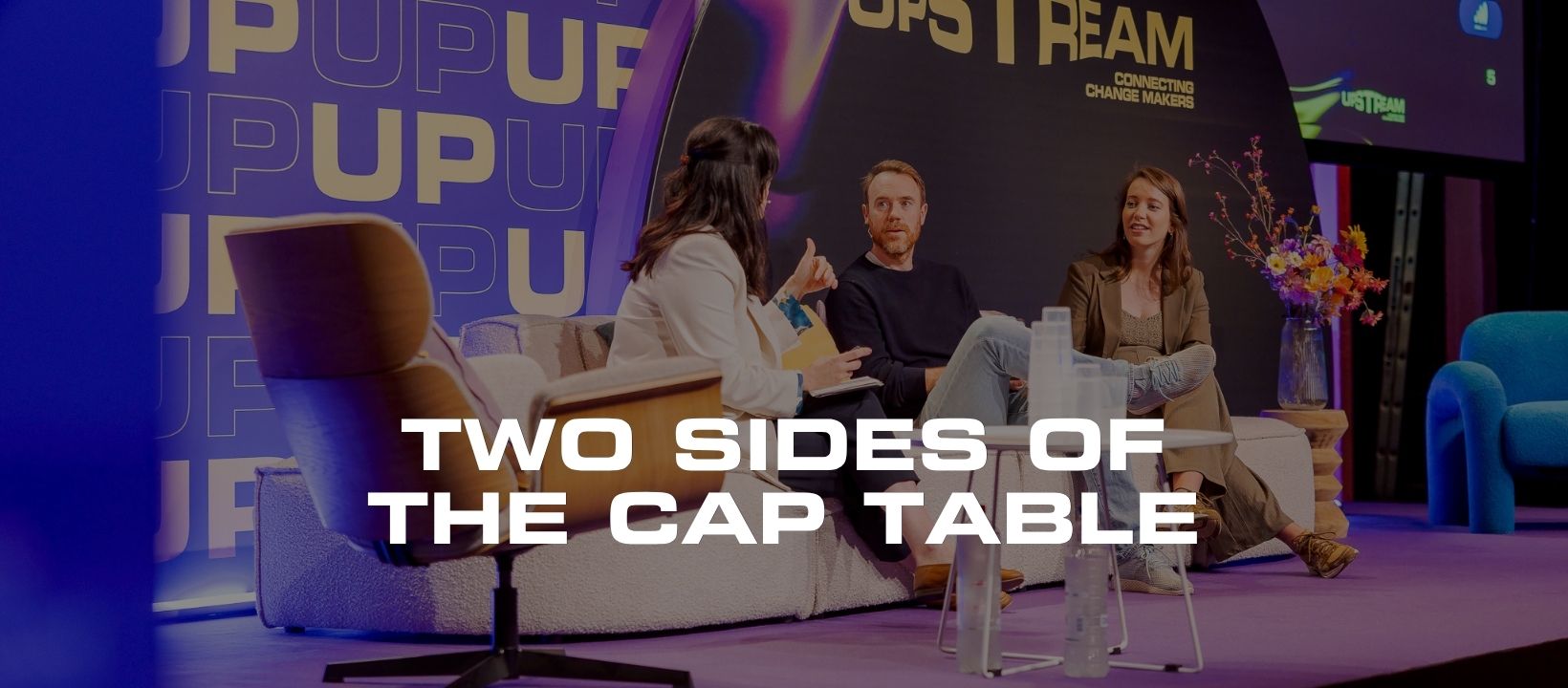
During the Upstream Festival panel Two Sides of the Cap Table, founder Krijn de Nood and investor Sophie Heijenberg explored the questions that often sit beneath fundraising conversations but are not always discussed openly.
Heijenberg is a seed-stage investor at Graduate Ventures, backing founders in areas including deeptech, climate, health and AI. De Nood is currently building iconic works, an AI-native operating system for large capital projects. He previously co-founded and led cultivated-meat company Meatable.
Their perspectives came from opposite sides of the cap table, but the discussion revealed considerable common ground. Raising capital is not the goal in itself. The real question is what will help a company build, learn and grow.
Bootstrap when it gives you an advantage
The panel opened with a question many founders face early in their journey: should a founder bootstrap if they can?
De Nood’s starting point was clear.
“I think it’s good as a founder to keep as much control as you can.”
Bootstrapping can give founders freedom. It allows them to shape the company without external pressure, retain ownership and make decisions on their own timeline.
But the right answer depends on the market.
For a company operating in a fast-moving and competitive field, waiting too long can become a disadvantage. De Nood explained that iconic works initially considered bootstrapping, but the pace of development in AI changed the equation. The company needed to move quickly and invest accordingly.
The takeaway was not that every startup should raise funding. It was that founders need to understand what kind of race they are entering.
Capital should serve the strategy, not replace it.
Founder–market fit matters, but it is not the whole story
The next question was whether founder–market fit matters more than the size of the market.
At the earliest stages, investors are not only evaluating the idea. They are evaluating the people behind it. Can the founders keep going when plans change? Are they able to learn quickly? Do they understand the problem deeply enough to build something that customers genuinely need?
Heijenberg emphasised the importance of the founder, particularly when a company is still at an early stage. Markets shift and products evolve. The people building the company need the resilience and adaptability to move with them.
But de Nood added an important nuance. Deep industry experience can be valuable, but it can also create blind spots. Some of the most interesting companies are built by people who question the assumptions insiders have stopped noticing.
When he co-founded Meatable, cultivated meat was not his existing area of expertise. He approached it by looking at long-term trends and asking which major problems would need to be solved over the coming decades.
Knowing a market helps. But seeing it differently can also be an advantage.
Venture capital needs a venture-scale opportunity
A strong founder alone is not enough to make a business suitable for venture capital.
Heijenberg highlighted a point that can easily be overlooked in early fundraising conversations: not every good business is a VC business. Different funds have different models, target returns and investment strategies. A company needs to understand whether its potential market can support the scale a particular investor requires.
That does not make a smaller or differently structured business less valuable. It simply means that founders need to choose the right financing path.
The question is not only whether investors want to invest.
It is also whether venture capital is the right instrument for the company founders want to build.
Give founders enough room to experiment
The conversation also touched on the relationship between funding and trust.
De Nood argued that the best investors give founders enough breathing room to build. Early-stage companies need space to test assumptions, try different approaches and learn from the things that do not work.
“You need to try some stuff, and some stuff might go wrong. That should not be the end of the world.”
Raising too little can keep founders trapped in a cycle of continuous fundraising. Instead of focusing on customers, product and team, management attention is repeatedly pulled back towards the next round.
“Fundraising takes a lot of time. It takes management away from building.”
At the same time, more money is not automatically better. Too much capital can create pressure to spend before a company is ready. It can encourage premature scaling or distract the team from the fundamentals.
The aim is not to maximise the size of a round. It is to raise enough capital to create the right conditions for learning and progress.
“In the end, it’s just about building a company.”
Look beyond borders, but do not overlook the Netherlands
The final discussion focused on the Dutch investment landscape.
Should founders default to international investors when raising a substantial round?
Heijenberg challenged the either-or framing.
“I don’t agree with only looking abroad. I think it’s about a combination.”
International investors can bring valuable networks, market knowledge and experience with larger rounds. For companies with global ambitions, that perspective matters.
But local investors also play an important role. They understand the ecosystem, can build relationships with founders at an earlier stage and demonstrate confidence in companies emerging from the Netherlands.
A healthy funding strategy may involve both: strong local investors who know the company and its context, combined with international partners who can help it reach the next stage of growth.
A cap table is more than a spreadsheet
A cap table records ownership. But the panel made clear that it also reflects a set of relationships.
Founders need investors who understand what the business is trying to achieve and who can provide the right kind of support at the right moment. Investors need founders who think carefully about the market, learn quickly and understand the responsibility that comes with taking external capital.
The strongest companies are not built by choosing one side of the table over the other.
They are built when both sides understand what they are there to do: create the conditions for something valuable to grow.