June 3, 2026
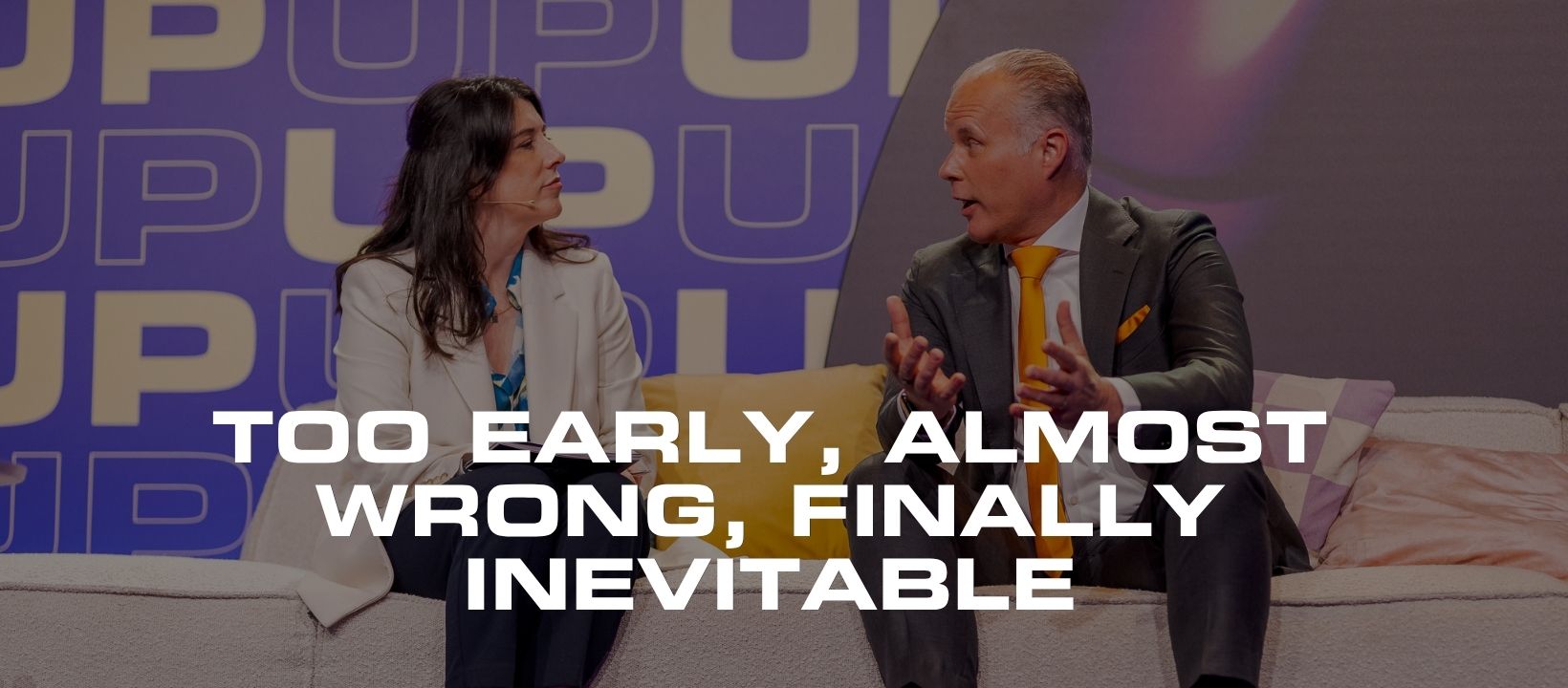
Too early, almost wrong, finally inevitable: Siete Hamminga on surviving before the market catches up
What happens when you build the right solution at the wrong time?
For founders, being early can sound exciting. It suggests vision, instinct and the ability to see an opportunity before the rest of the market notices it.
In practice, being early can be difficult.
Customers may not understand the problem yet. Investors may struggle to see the commercial opportunity. The technology may work, but the urgency is missing. A company can spend years building towards a future that still feels distant.
During his Upstream Festival session, Too Early, Almost Wrong, Finally Inevitable, Robin Radar Systems founder and CEO Siete Hamminga shared what it takes to survive that period.
His story is not about following a straight path from an idea to a successful business.
It is about staying committed to a larger vision while remaining honest enough to question whether the route towards it is still the right one.
Seeing an opportunity in a struggling project
Robin Radar Systems began with technology developed within TNO.
The original radar project focused on tracking birds. For airports, this is a serious safety issue. Bird strikes can cause significant damage, while traditional monitoring methods cannot provide a complete picture of what is happening across a large airfield.
Hamminga saw commercial potential in the technology and decided to build a company around it.
The initial focus was clear: help airports understand bird movements more accurately and reduce the risks associated with bird strikes.
But while developing and testing the system, the team encountered another possibility.
Drones were starting to become more accessible. Their potential uses were expanding quickly. So were the risks.
Robin Radar had built technology designed to detect small moving objects in the sky. The team began to recognise that the same underlying expertise could become relevant in a much larger security market.
The challenge was timing.
Robin Radar could see the problem before many potential customers considered it urgent.
When the market is not ready yet
In 2014, the company began working seriously on drone detection.
The opportunity appeared clear to Hamminga. Small drones would become more capable, more widely available and more difficult to ignore. Critical infrastructure, governments and defence organisations would eventually need reliable ways to identify them.
But the market had not caught up.
“You can show what drones are capable of, and people still do not really agree that this will become a major issue.”
For founders, this is one of the hardest situations to navigate.
If a market already exists, customers understand the problem. The conversation is about why one solution is better than another.
If the market is still emerging, the company first needs to explain why the problem matters at all.
That changes the sales process. It changes the fundraising story. It also changes the amount of patience the team needs.
Build a bridge to the future
Robin Radar did not abandon its original bird-detection business while waiting for demand for drone radar to grow.
That existing market created a foundation.
The company continued serving customers in aviation and other sectors where bird monitoring already solved a concrete problem. That work generated revenue, improved the technology and helped the team build credibility.
At the same time, the company kept investing in the emerging drone-detection opportunity.
The broader lesson is important.
When a founder sees a future market, the company may still need a bridge to reach it.
That bridge could be an adjacent customer segment, a smaller version of the product or an application that creates value today while the larger opportunity develops.
The bridge is not necessarily a distraction.
It may be what allows the company to remain alive long enough for the market to catch up.
Persistence or stubbornness?
Hamminga reflected openly on one of the most difficult decisions founders face.
When should you keep going?
And when should you accept that something is not working?
“When are you the hero pursuing your vision, and when are you on a broken ship trying to pursue something that was never justified?”
There is no simple formula.
Persistence is celebrated in entrepreneurship. Founders are often told to believe in the mission, ignore the doubters and keep moving through difficult periods.
But courage is not only the willingness to continue.
“It also takes courage to acknowledge that something does not work and change direction.”
Founders need conviction. They also need the ability to challenge their own assumptions.
The aim is not to protect the original plan at all costs.
The aim is to keep solving the problem.
Face the brutal facts without losing faith
Hamminga described a principle that helped him navigate uncertainty:
“Face the brutal facts, but never lose faith.”
Both parts matter.
Optimism without evidence can become denial.
Evidence without optimism can make a founder give up just before the opportunity starts to emerge.
The challenge is to hold both positions at the same time.
A founder needs to see the obstacles clearly. They need to understand the cash position, listen to customers and recognise when sales cycles are longer than expected. They need people around them who are willing to ask difficult questions.
But they also need enough belief to continue when the available evidence is incomplete.
In an emerging market, certainty often arrives late.
The founder has to make decisions before it does.
Hire people who challenge you
A company cannot make those decisions well if everyone agrees with the founder.
Hamminga emphasised the importance of surrounding yourself with people who think differently.
A supportive team is valuable. A team that simply confirms every assumption is dangerous.
“If you really want to step up, you need other thinkers who have healthy conflict over the facts.”
He shared a story about meeting someone who challenged him during an early conversation. His first instinct was that the person was annoying.
Then he reconsidered.
The reason the conversation felt uncomfortable was that the person was asking questions other people avoided. They were not automatically impressed by what had already been built.
Hamminga hired him.
The lesson is not that every disagreement is useful.
It is that founders should not confuse agreement with quality.
A strong team includes people who are prepared to say what the founder may not want to hear.
A competitor may become a customer
As Robin Radar expanded into drone detection, the company faced a familiar concern.
What happens when a much larger organisation decides to enter the market?
Founders often see major corporations primarily as threats. They have more resources, larger teams and established customer relationships.
But smaller companies also have advantages.
They can focus deeply on a specific technical challenge. They can move quickly. They can develop specialist expertise that a larger organisation may not want to recreate internally.
Robin Radar’s relationship with Thales became an example of that dynamic. Rather than becoming a fight between a small company and a large one, the relationship developed into a partnership.
“There is a very thin line between competition and partnership.”
A company that initially appears to be a competitor may become a customer, distribution partner or strategic ally.
Founders should take competition seriously.
But they should also remain open to the possibility that the strongest route to market may involve working with organisations they once viewed as a threat.
Share the problems, not only the successes
Hamminga also challenged the instinct to hide difficulties.
Founders often feel pressure to communicate constant progress. Every update should sound positive. Every conversation should reinforce the impression that the company is moving forward without hesitation.
But this can become counterproductive.
“I share my challenges and my ideas, especially in a room like this.”
Being open about a challenge can create unexpected opportunities.
Somebody may recognise the problem from their own experience. A potential partner may have a solution. An advisor may be able to make a useful introduction. Another founder may simply offer the reassurance that the struggle is not unusual.
Transparency does not mean sharing every detail with everyone.
It means recognising that pretending everything is perfect can prevent the right people from helping.
Culture comes before strategy
As Robin Radar grew, Hamminga’s own role needed to change.
A founder who builds a small team cannot lead a much larger company in exactly the same way. New stages require different skills, different structures and a willingness to let go of some responsibilities.
“You need to reinvent yourself on time.”
Hamminga spoke about hiring people who were better suited to parts of the job he did not enjoy or could no longer handle alone.
That required self-awareness.
Founders do not need to be the strongest person in every discipline. Their job is to create the conditions in which the company can succeed.
“You do not have to do everything yourself.”
A strong culture makes that easier. It allows people to take responsibility, challenge assumptions and make decisions without waiting for the founder to approve every detail.
“Culture eats strategy for breakfast.”
A brilliant plan will not compensate for a team that cannot work together.
A strong team can continue adapting long after the original plan has changed.
Hire for the company you are becoming
Hamminga encouraged founders to think beyond the immediate vacancy when building a leadership team.
“Do not hire the person you need today. Hire the person who fits the company you will be in three years.”
This can be difficult for an early-stage company.
Experienced people are expensive. Founders may hesitate to bring in senior talent before the company appears large enough to justify it.
But waiting too long creates a different risk.
The company may grow faster than its structure. The founder may become a bottleneck. People who were right for an earlier phase may struggle to support the next one.
Hiring for the future does not mean building a large organisation prematurely.
It means understanding where the company is heading and involving people capable of helping it reach that destination.
You only need to be right once
Robin Radar spent years developing technology for markets that were still evolving.
Some parts of the journey took longer than expected. Some opportunities emerged more quickly. Some large deals required patience. Others moved surprisingly fast once the urgency became clear.
That uneven path is part of building in an emerging market.
A founder cannot control the exact moment when the market becomes ready.
But they can decide whether the company will still be there when it happens.
They can build a bridge to the future. They can remain honest about the facts. They can hire people who challenge them. They can stay open to partnerships that initially look like competition.
Being early is not automatically a competitive advantage.
Surviving long enough to become inevitable is.