September 2, 2026
• By Upstream Festival
Rotterdam for maritime startups and port innovation
Maritime innovation has always been linked to movement.
Ships, cargo, energy, people, data and infrastructure all need to work together across borders and across systems. When something changes in the maritime world, the effects are rarely small. A better route, cleaner fuel, smarter terminal process or safer inspection method can influence entire supply chains. That is why maritime startups matter.
The sector is facing big transitions at the same time: decarbonisation, digitalisation, automation, geopolitical uncertainty, pressure on infrastructure and the need for more resilient logistics. These are not abstract challenges. They affect ports, shipping companies, offshore operators, cargo owners, governments, insurers and everyone who depends on goods moving reliably.
For founders building in this space, Rotterdam offers a rare advantage. It is a city where maritime ambition sits close to real operations. The port, the companies around it, the knowledge institutions, investors, public partners and startup support organisations create an environment where new ideas can be tested against practical reality. That is why Rotterdam matters for maritime startups and port innovation.
A port where problems are visible
Founders often hear that they need to stay close to the customer. In maritime and port technology, that advice becomes even more important.
A startup working on emissions measurement, autonomous inspection, berth planning, predictive maintenance, shore power, safety, cybersecurity, cargo visibility or offshore energy cannot build in isolation for very long. The product needs to fit into complex operations. It needs to work around physical assets, safety rules, data limitations, procurement processes and the daily pressure of keeping goods moving. Rotterdam gives founders proximity to those realities.
The Port of Rotterdam is one of the world’s most important gateways for trade and industry. For a maritime startup, that creates access to the types of questions that matter: where delays happen, where emissions can be reduced, where infrastructure needs to become smarter, where manual processes still slow things down and where established organisations are actively looking for new solutions.
A strong port ecosystem helps founders move from assumption to evidence. It gives them a better understanding of what customers actually need and what it takes to make a solution useful in a high-stakes environment.
Port innovation needs trust
A port is a complicated place to introduce new technology.
The customer may be a port authority, a terminal operator, a shipping company, a logistics provider, an offshore company, a public body or a corporate partner with several departments involved in the decision. The person who likes the idea may not control the budget. The person who controls the budget may need proof that the solution can be deployed safely and reliably. The people who will use the product may have concerns that never appear in the first pitch meeting.
Startups need partners who are willing to explore a solution before every detail is proven. Established organisations need founders who understand the seriousness of the environment they are entering. Both sides need enough time to learn whether the solution can work beyond a demo.
A good pilot can help. It gives the startup a route into the operational context and gives the partner a way to test the technology without committing too early to a full rollout. For maritime startups, pilots are often the bridge between a promising idea and a credible commercial case.
Rotterdam has built much of its innovation strength around this type of practical collaboration. Accelerators, innovation hubs, corporates, public partners and sector specialists create routes for founders to meet the right people and understand what a real partnership would require.
Maritime startups need more than capital
Funding is important, especially for founders building products that involve hardware, infrastructure, regulation or long enterprise sales cycles. Maritime technology can take longer to validate than a pure software product. A founder may need to work through technical testing, certifications, safety requirements, procurement timelines and customer education before revenue starts to scale.
That makes capital important, but it also makes the right network essential.
A maritime startup may need access to a vessel, terminal, quay, data source, engineering partner, launching customer or specialist advisor before an investor can fully understand the opportunity. In some cases, a strategic partner can be as important as an early cheque.
This is one of Rotterdam’s strengths. The city brings founders closer to the organisations that can help turn a maritime concept into something that can be tested, improved and eventually adopted.
For maritime tech investors, this proximity also matters. It gives them a clearer view of the market, the customer pain and the practical route to adoption. The strongest investment cases in port technology are often built through a combination of technical insight, customer validation and sector access.
Where maritime startups can make an impact
The maritime sector is full of problems that are large enough for startups to matter.
Decarbonisation is one of the most visible. Shipping, port operations and offshore activity are all under pressure to reduce emissions and improve efficiency. Startups can contribute through fuel optimisation, emissions tracking, electrification, shore power, route planning, circular materials, battery systems, hydrogen applications and energy management.
Digitalisation is another major opportunity. Many processes in maritime and logistics still rely on fragmented systems, manual coordination and data that does not move easily between stakeholders. Startups can help improve planning, visibility, documentation, compliance, asset management and decision-making.
Safety and security are also becoming more urgent. Ports are critical infrastructure. The sector needs better ways to monitor risks, protect digital systems, inspect assets, manage drones, detect anomalies and respond to incidents.
Automation will continue to shape the sector, from autonomous vessels and smart terminals to robotics, computer vision and AI-supported decision-making. The opportunity is large, but adoption depends on solutions that can prove their reliability in demanding environments.
For founders, this means the market is full of meaningful problems. It also means the bar is high. Maritime customers need solutions that respect operational complexity and create measurable value.
Why Rotterdam is a useful place to build
Rotterdam’s maritime ecosystem gives founders several advantages at once.
There is the port itself, with its global relevance and operational scale. There is a strong regional cluster of maritime, offshore, logistics and energy companies. There are knowledge institutions and technical talent connected to maritime engineering, logistics, sustainability and digital technology. There are initiatives such as PortXL, RDM Rotterdam and other innovation networks that help connect startups with corporates, mentors and potential partners.
This combination matters because maritime innovation usually develops through relationships.
A founder may start with one conversation, then a demonstration, then a small pilot, then a larger partnership. Each step depends on credibility. Each step requires the startup to understand what the customer needs next.
Rotterdam gives founders a better chance of building that credibility close to the sector.
It also creates a stronger environment for startup networking. A maritime startup event in Rotterdam can bring together founders, investors, port leaders, corporates and public partners who already share a connection to the sector. That makes the conversations more focused and the follow-up more practical.
What founders should prepare before approaching the port ecosystem
Founders who want to work with maritime or port partners need a clear story, but they also need to show that they understand the environment.
A strong starting point is to define the problem in operational terms. What exactly is slow, expensive, risky, polluting or inefficient? Who experiences the problem most directly? What happens if it remains unsolved? How does the solution fit into existing workflows?
The next step is to be specific about proof. A port or maritime partner needs to know what a pilot would test, how success would be measured, what resources are required and what risks need to be managed. A useful pilot plan makes it easier for a partner to say yes because it reduces uncertainty.
Founders should also think carefully about who needs to be involved. Maritime decisions often include technical, operational, commercial, legal, safety and sustainability perspectives. A good founder learns how those perspectives connect.
For startups coming to a port innovation event or maritime innovation conference, preparation makes the difference. The most useful conversations often start before the event itself: researching the right people, understanding their priorities and knowing what kind of introduction or feedback would move the company forward.
Why events still matter in maritime innovation
In sectors built around trust, infrastructure and long-term relationships, events can play a practical role.
A startup event in Rotterdam gives founders access to people they may otherwise struggle to reach. It can create first conversations with investors, potential customers, port leaders, corporates and other founders working through similar challenges.
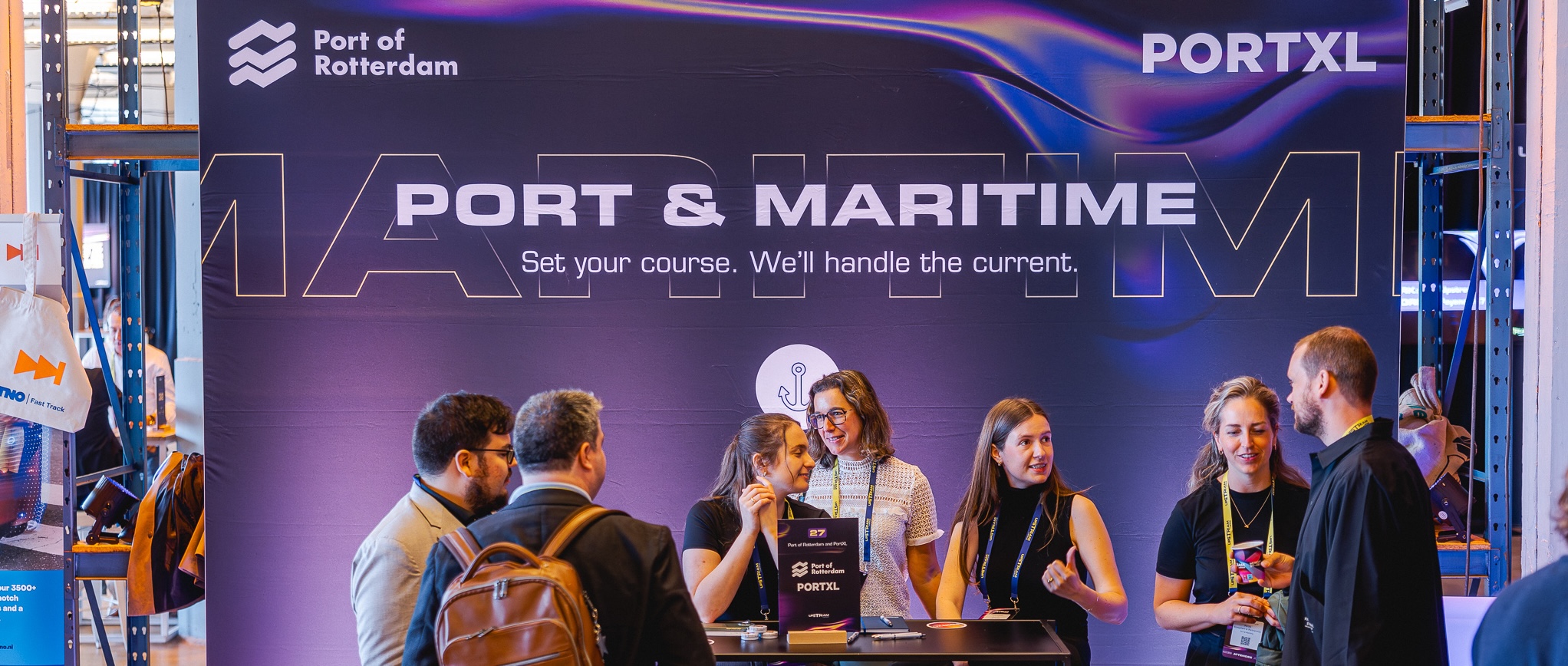
For Upstream, the Port & Maritime track is designed around that practical need. It brings together startups, investors and industry partners who are working on the future of ports, logistics and maritime innovation. The value is in the concentration of relevant people and the intention behind the meetings.
A strong port innovation event should help founders leave with more than inspiration. It should help them understand the next step: which partner to speak to, which assumption to test, which investor might be relevant, which customer problem needs sharper definition and which part of the market is ready to move.
Rotterdam’s role in the future of maritime innovation
Maritime innovation will shape how Europe trades, moves goods, secures infrastructure and manages the transition to cleaner energy.
Rotterdam has a meaningful role to play because it brings the future of the sector close to the companies and institutions already operating within it. The city has the scale, the industrial base, the technical networks and the startup activity needed to turn ideas into practical progress. For maritime startups, that combination is valuable.
The sector needs founders who can work with complexity, build trusted partnerships and stay close to the operational realities of the market. Rotterdam gives those founders a place where the right conversations can happen and where port innovation can move from promise to implementation.
That is what makes the city important for the next generation of maritime technology. And it is why founders building in port, logistics, offshore, climate and maritime should pay attention to Rotterdam.