June 3, 2026
From pitch to partnership: how SolarDuck and Q*Bird turn ambitious technology into real-world projects
For some startups, winning a customer can happen quickly. A product is demonstrated. A contract is signed. The solution is deployed within weeks.
For deep-tech companies, the journey often looks very different.
The technology may be new. The infrastructure may not yet exist. The customer may need time to understand what is possible, involve multiple departments and build the internal support required to move forward.
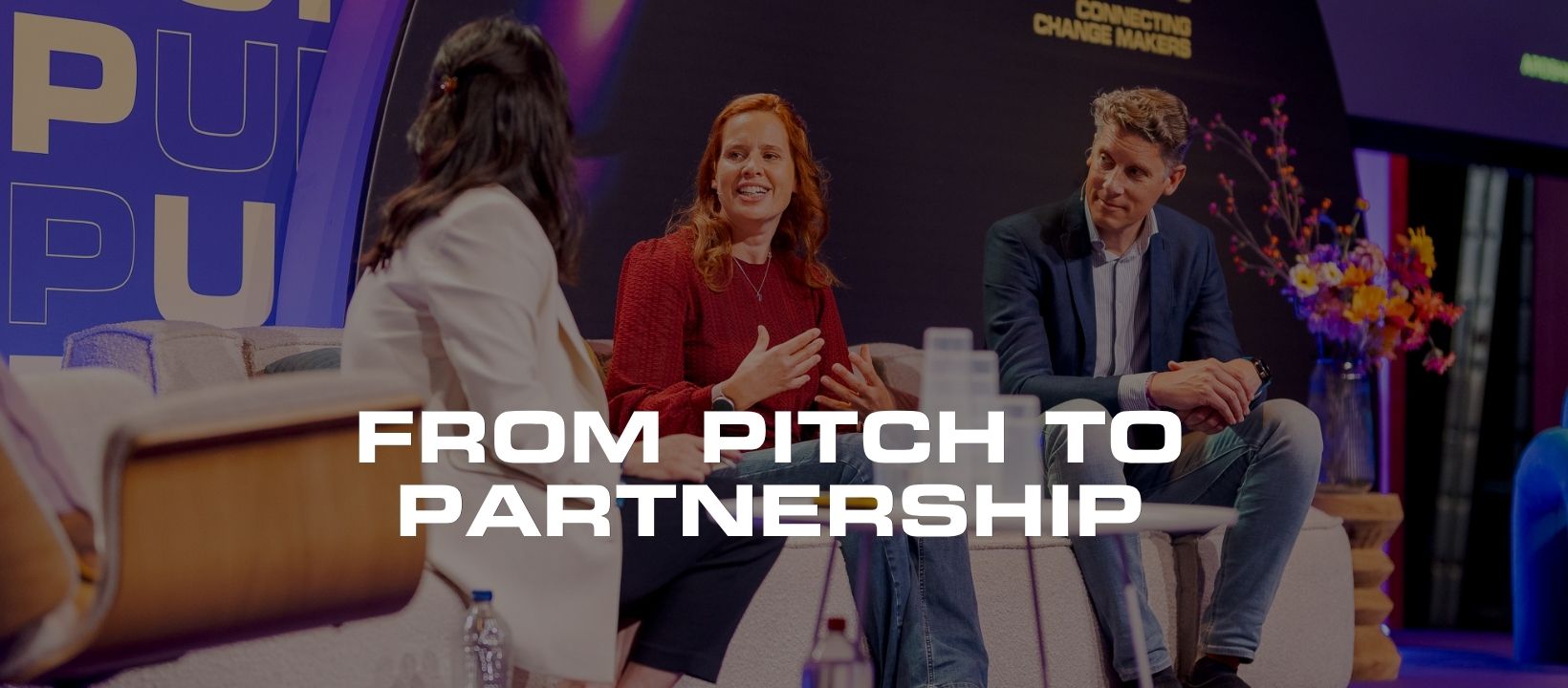
During the Upstream Festival panel From Pitch to Partnership: Scaling with Corporates and Government, SolarDuck co-founder and CEO Koen Burgers and Q*Bird co-founder and CEO Ingrid Romijn discussed what it takes to build partnerships when the road from idea to implementation is measured in years rather than weeks.
Their companies operate in very different fields.
SolarDuck develops offshore floating solar technology, creating new opportunities to generate renewable energy at sea.
Q*Bird builds quantum-secure communication networks designed to protect critical infrastructure today while preparing for the quantum internet of tomorrow.
But both founders have faced a similar challenge: how do you persuade organisations to invest time, money and trust in a technology that is still creating its own market?
A pitch is only the beginning
For a deep-tech company, the first meaningful partnership is rarely a standard sales transaction.
The customer is not simply buying an established product. They are often stepping into unfamiliar territory with the startup.
That makes trust essential.
Romijn explained that Q*Bird builds quantum network systems: infrastructure that can secure communications between locations today and, in the future, connect quantum computers and other quantum devices.
“We build the digital infrastructure of the future based on quantum technology.”
That future-facing ambition is compelling. But organisations still need to understand how the technology can help them now.
For Q*Bird, early pilots and demonstrations played an important role in moving the technology from a research setting towards real-world use. The Port of Rotterdam became a valuable launching partner, giving the company an opportunity to demonstrate secure communication within critical infrastructure.
The project was not the result of a single pitch.
It grew through conversations, demonstrations, research and the involvement of partners willing to explore what the technology could become.
Start with something people can see
SolarDuck has faced a similar challenge.
Offshore floating solar is a new category. Explaining it on a slide is not enough. Potential customers and partners need to see that the technology can operate in the demanding conditions found at sea.
That is why demonstrators matter.
They make an ambitious concept more tangible. They create something that partners can visit, discuss and evaluate. They give teams a shared reference point and turn a theoretical conversation into a practical one.
For a deep-tech founder, a pilot is not merely a smaller version of the end product.
It is a tool for building belief.
A strong demonstrator creates evidence. It also gives potential partners the confidence to take the next step.
Break the journey into smaller steps
Large infrastructure projects take time.
A company cannot always wait years for the final contract before generating revenue, learning from customers or showing progress to its team and investors.
“We need to break things down.”
Burgers explained that SolarDuck divides the larger journey into smaller steps. Instead of treating a large-scale project as one distant objective, the team works towards a series of milestones that create value along the way.
That could mean research, engineering work, feasibility studies, testing or smaller deployments.
The exact steps will differ for every company. The principle remains the same.
When the final ambition is large, founders need to identify the smaller commitments that help customers move forward with confidence.
This approach also keeps the team engaged. Progress becomes visible. Learning happens earlier. And the company can strengthen its proposition before it reaches the largest and most complex stage of deployment.
Build relationships before you need the contract
Long sales cycles require a different approach to business development.
Romijn described a process that can take considerable time.
“It can take up to two years. It’s really long, and we need to keep in contact, invite them to the demos and talk to them.”
This does not mean chasing a customer for two years with the same pitch.
It means building a relationship around learning.
Potential partners need opportunities to see the technology develop. They need to understand how the solution fits into their organisation. They may need to involve colleagues in technical, operational, legal or procurement roles.
The startup needs to listen as well.
What does the organisation need before it can move forward? Which concerns are holding the project back? Who needs to be involved in the conversation? What proof points will make the next decision easier?
A long cycle can feel frustrating.
But it can also create a stronger partnership when both sides use the time well.
Find the people who believe in the idea
Large organisations are rarely moved by a single decision-maker.
An ambitious partnership needs people on the inside who understand the opportunity and are willing to help move the project forward.
For startups, finding those people can be just as important as refining the technology.
“You need to have those people inside organisations who believe in this.”
An internal champion can help a startup navigate the organisation, involve the right stakeholders and explain why a project matters. They understand the internal context and know how decisions are made.
This is especially important when the technology is new.
A procurement process may be built around familiar solutions. Budgets may be allocated according to existing categories. Different departments may have different priorities.
The internal champion helps translate the startup’s ambition into a case the organisation can support.
That does not mean bypassing the formal process.
It means ensuring that the formal process has a reason to begin.
Delivery matters more than the initial excitement
A strong pitch can create interest.
A pilot can create momentum.
But neither is enough to build a lasting partnership.
“You also have to keep delivering and manage those expectations.”
The work becomes more demanding after the initial enthusiasm. The startup needs to communicate clearly, meet its commitments and be honest about what remains uncertain.
This can be difficult when a company is still developing the technology.
Founders want to show ambition. Customers need reliability. Teams want to move quickly. Complex systems do not always cooperate with the timeline.
The answer is not to pretend that every part of the journey will be easy.
It is to manage expectations thoughtfully and deliver what has been promised.
A partner that feels informed is more likely to stay engaged when a project encounters challenges.
Be transparent when the market changes
Deep-tech companies do not operate in a vacuum.
Regulation changes. Public priorities shift. New funding opportunities emerge. Established markets slow down. New use cases become more relevant.
Burgers discussed the importance of responding openly when circumstances change.
A setback does not automatically mean that the core technology is wrong. But it may mean that the company needs to look for additional applications, adjust the timing of its plans or develop another route to market.
Transparency matters internally too.
Teams can usually sense when something has changed. Avoiding difficult conversations does not protect people. It creates uncertainty.
The stronger approach is to explain the situation clearly, involve the team in the response and keep moving.
Curiosity is a practical advantage
The founders also discussed the qualities that matter when building a company around emerging technology.
Patience is part of the answer.
People need to understand that meaningful progress may take time. They need to feel comfortable working through uncertainty and solving problems that do not come with an established playbook.
But patience should not be confused with passivity.
Curiosity matters just as much.
“Curious. That’s something that we value.”
A curious team keeps looking for new applications, new partners and new ways to solve the problem.
When the market changes, curiosity helps the company adapt.
When a customer raises a concern, curiosity turns the concern into a question worth exploring.
When a project encounters a setback, curiosity helps the team search for the next route forward.
Partnerships create markets
SolarDuck and Q*Bird are building technologies that require more than customers.
They need partners.
They need organisations prepared to test, learn and create new possibilities together.
For corporates and governments, that means looking beyond the immediate procurement question. A pilot with an emerging technology company is not only a purchase. It can also be an opportunity to shape a solution that will matter in the future.
For startups, the lesson is equally clear.
Do not treat the first pitch as the finish line.
Build something people can see. Break the larger ambition into manageable steps. Find the internal champions who understand why the project matters. Communicate openly. Keep delivering.
A strong partnership is not created in a single meeting.
It is built through the work that happens afterwards.