July 29, 2026
Founder turned investor: Thijn van Helvoirt on building with data and raising with purpose
What makes someone a better investor? For Thijn van Helvoirt, the answer was to become a founder first.
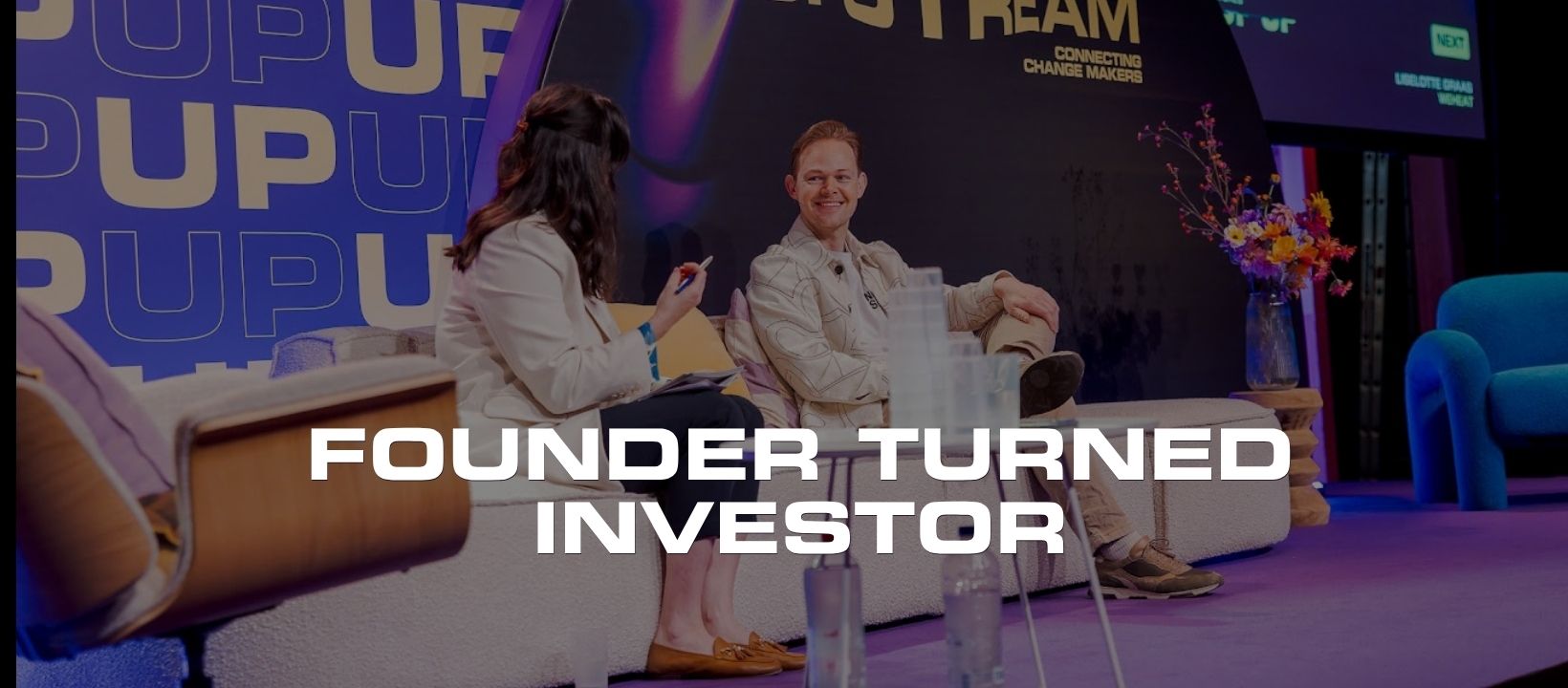
During his Upstream Festival fireside chat, Building & Raising from Both Sides of the Game, the Partner at No Such Ventures reflected on his journey from lawyer to startup founder to investor. He shared lessons from building shared-mobility scale-up Check and explained how his operating experience now shapes the way he evaluates and supports other founders.
The conversation was not about fundraising as an end goal. It was about something more fundamental: how to build a company that deserves to grow.
From lawyer to founder to investor
Van Helvoirt started his career as a lawyer. But his long-term ambition was to work in venture capital.
As he looked at the investment world, he saw a challenge. How could he become the kind of investor that founders would genuinely value? How could he understand what it takes to build a company if he had never been responsible for doing it himself?
The answer was to step onto the other side of the table.
He co-founded Check in 2018, when shared mobility was rapidly expanding across European cities. The sector attracted significant investment, but many operators were pursuing growth before they had proven that the underlying business model worked.
Check took a different approach.
The team focused on the details: the economics of each vehicle, operational efficiency and the everyday experience of the people using the service.
Measure everything
One of Van Helvoirt’s clearest lessons from building Check was also one of the simplest.
“Measure everything.”
When a company is performing well, it can be tempting to celebrate the result and keep moving. But Van Helvoirt argued that success deserves just as much analysis as failure.
Why is the product working? Why are customers choosing it? Is the company cheaper, faster or easier to use? Which parts of the model could be repeated in another city, and which parts depend on circumstances that may not scale?
“You need to analyse what is actually different. Why are we successful?”
At Check, data helped the team improve both its operations and its product. Rather than solving every challenge manually, the company used technology to make smarter decisions about where vehicles should be positioned and how the service could become more efficient.
The same approach applied to the app itself. The team tested different screens, buttons and steps in the customer journey. Whenever an unnecessary step created friction, they questioned whether it needed to be there at all.
The goal was not complexity.
It was to make the experience as simple as possible.
Combine hustle with data
Data was also at the centre of Van Helvoirt’s advice to founders preparing to raise capital.
“Founders should combine hustling with really looking at data.”
At an early stage, a startup may not yet have significant revenue. It may not have thousands of customers or years of performance data. But that does not mean founders should rely solely on a compelling vision.
Evidence can be created.
Founders can speak with potential customers, test whether people are interested in the problem and learn which part of the proposition resonates. They can run a small marketing experiment before asking investors to fund a much larger campaign. They can document what they tried, what happened and what they learned.
“There’s always commercial validation to find. You just need to go out there to get it.”
The point is not to pretend that an early test proves everything. It does not.
But a founder who actively creates evidence demonstrates curiosity, initiative and a willingness to challenge their own assumptions. That matters when investors are deciding who has the ability to turn an idea into a scalable business.
Profitability and growth are not opposites
During the audience Q&A, Van Helvoirt was asked whether startups should prioritise profitability or scale as quickly as possible.
His response was nuanced. There is no universal route.
For Check, proving that the unit economics worked was important. But reaching profitability at one moment did not mean the company should stop investing in growth. Expanding into new cities required capital, and that could temporarily move the company away from profitability again.
The important question is not whether a company is profitable at every stage.
It is whether the founders understand the logic behind their decisions.
What does success look like for this specific business? Which assumptions need to be proven before the company scales? When does investment accelerate a model that works, and when does it merely hide a model that has not yet been tested properly?
Capital can support growth.
It cannot replace a strategy.
Investors should be original too
Van Helvoirt did not reserve his advice for founders. Investors also need to think carefully about how they show up.
“Be out there and be original.”
Founders are constantly expected to communicate clearly, build relationships and stand out in competitive markets. Investors should not expect to be exempt from the same challenge.
At No Such Ventures, that can take playful forms. The team has used creative term sheets tailored to the founders receiving them. One was delivered on a floppy disk to a founder with a connection to the software industry of the 1990s. Others have been adapted to fit the story of a particular company.
The gestures are small, but the thinking behind them matters.
Investment is not only about winning access to a promising company. It is the start of a relationship. A thoughtful approach shows founders that an investor has listened and that the people behind the fund care about more than the transaction.
Capital plus relevant experience
No Such Ventures is built around the idea that founders benefit from more than funding alone.
Its collective brings together experienced entrepreneurs who have built companies themselves and can offer practical support to the next generation. The aim is not to overwhelm founders with advice. It is to connect them with people who understand the specific challenges they are facing.
For a fintech company, that might mean access to someone who has built in financial services. For a consumer platform, it might mean learning from an entrepreneur who understands how to scale a marketplace.
The fund focuses on European companies where software sits at the centre of the value proposition.
“It needs to be software-first. It doesn’t mean software only. But the magic should be in the software.”
The distinction is important. A company may operate in mobility, logistics, energy or another sector with a significant physical component. But its ability to scale should come from the technology behind the model.
Build before you celebrate
Van Helvoirt’s experience on both sides of the cap table has shaped a grounded view of entrepreneurship.
Fundraising can be useful. A term sheet can be exciting. A successful round can create new opportunities.
But none of these things is the same as building a successful company.
The work still comes down to understanding customers, testing assumptions, analysing the results and knowing when capital can help a proven idea move faster.
The strongest founders do not choose between vision and evidence.
They bring both.