July 1, 2026
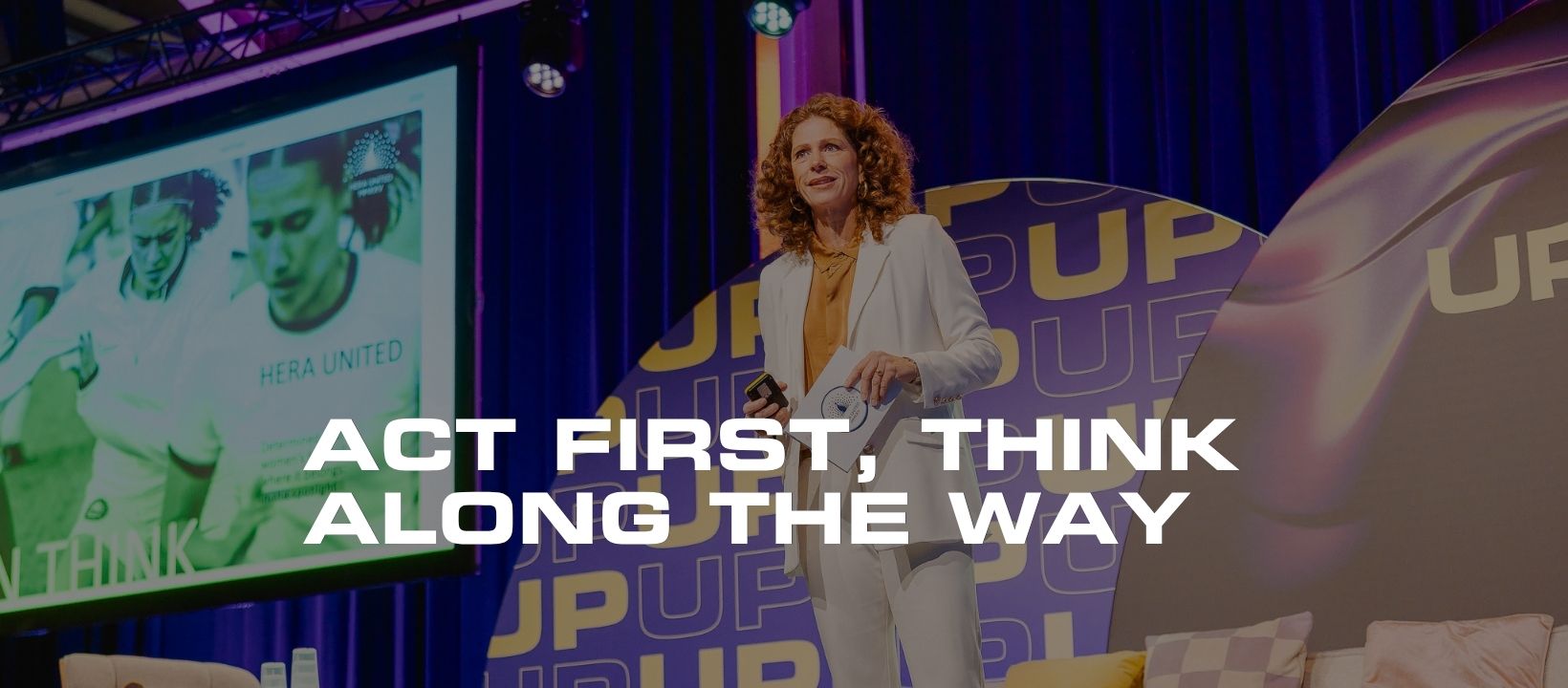
Act first, think along the way: Barbara Barend on building HERA United
What do you do when the system was never designed to include you? You question it. You challenge it. And, sometimes, you build something new.
Opening Upstream Festival 2026, sports journalist and entrepreneur Barbara Barend shared the story behind HERA United, the first independent professional women’s football club in the Netherlands. It was a keynote about football, but also about something every founder in the room could recognise: taking action before every answer is available, asking for what you need and refusing to accept that the existing rules are the only possible rules.
Starting with a simple question
Barend’s relationship with football started at an early age. Growing up, she was encouraged to believe that being a girl should never determine what she could or could not do. At home, the answer to her ambitions was simple: go for it.
The outside world did not always offer the same freedom.
When she wanted to join a football club at the age of six, boys her age were allowed to play. Girls were not. The explanation given at the time was that playing football at that age was medically irresponsible for girls.
Barend did not quietly accept the answer.
“This is discrimination,” she recalled saying.
The regulations eventually changed, allowing girls to start playing at the same age as boys. It was an early example of a pattern that would continue throughout her career: when a system does not make sense, question it.
Forty years later
Barend went on to work in sports journalism and built Helden Media, the sports content and production company that grew out of the magazine she founded with her father. But the experience that would lead her towards HERA United came much closer to home.
One evening, she was driving her daughter home from football training when her daughter described the difference between the opportunities available to the boys’ and girls’ teams.
“They don’t care about girls,” she said.
The words hit hard. Four decades after Barend had first challenged the rules that stopped girls from playing football, the inequality had not disappeared. It had simply taken different forms: fewer facilities, less attention, limited resources and fewer opportunities to grow.
That moment led Barend to look deeper into the structures surrounding women’s football. The question was no longer only how to create more visibility for women within the existing system. It was whether a different system needed to be built.
Making women’s football the main course
HERA United was created to be more than the women’s department of a club primarily built around men’s football. Everything is designed with women at the centre: the team, the commercial model, the brand and the ambitions for the future.
Together with Marieke Visser and Susan van Geenen, Barend helped turn the idea into a professional football club. The road towards the Eredivisie was far from straightforward.
At the time, the Dutch football system did not allow an independent professional women’s club to join the league. A women’s team could only participate through an existing professional club with a men’s licence.
“Nice idea, not going to happen,” was the initial response.
For Barend, it sounded familiar.
Instead of accepting the answer, the team worked to change the rules. They spoke with decision-makers, built a business plan, gathered support and approached investors. The story they told was not only about fairness. It was also about opportunity.
“This is not a foundation. This is business. Women’s football is growing.”
That distinction mattered. The goal was not to create a temporary initiative dependent on goodwill. It was to build a financially sustainable club with the potential to grow alongside the sport.
Asking for what you need
The process required persistence. It also required directness.
During her keynote, Barend spoke openly about the need to ask investors for money, to challenge the people holding decision-making power and to keep moving forward even when the final outcome remained uncertain.
“Ask for what you want. Do you want money? Ask for money.”
The rules were changed. The licence was secured. HERA United made its Eredivisie debut in September 2025 as the first independent professional women’s football club in the Netherlands.
But Barend was careful not to present the journey as a one-person success story. It was the result of a team, a growing network of supporters and the work of people willing to challenge assumptions that had been treated as fixed for too long.
Question the status quo
The lesson Barend left with the Upstream audience was clear.
“Yes, you can fix the system. If the system is not right, keep questioning the status quo.”
For founders, that might mean entering an industry that is not ready for a new model. For investors, it might mean looking beyond established assumptions when deciding where future growth will come from. For ecosystem builders, it might mean asking whether the current structures are truly giving new ideas a fair chance.
Changing a system takes time. It can be uncomfortable. It often means hearing no more than once.
But sometimes the answer is not to wait for permission.
Sometimes the answer is to start building.